Visual Field Test in Mesa, AZ: Catches What 20/20 Misses
You can read the 20/20 line on an eye chart, feel like your vision is perfect, and still be quietly losing part of your visual field. In conditions like glaucoma, that vision never comes back.
It’s the reason visual field testing exists.
According to the CDC, about 3 million Americans have glaucoma, and because the early stages usually cause no symptoms at all, roughly half of them don’t know it. Glaucoma has earned the nickname “the silent thief of sight” for exactly this reason: it typically takes vision from the edges inward, so gradually that the brain compensates until real damage is done.
Visual field testing is how eye doctors catch and track that kind of loss. And at Carrot LASIK & Eye Center in Mesa, Arizona, visual field testing is now performed on a wearable headset platform rather than the traditional tabletop perimeter, using the same trusted diagnostic protocols (the 24-2, 10-2, and 30-2) that ophthalmologists have relied on for decades.
Carrot LASIK & Eye Center invests in advanced diagnostic technology, including wearable visual field testing, because staying at the forefront of eye care isn’t about owning new equipment. It’s about making sure that when a patient in Mesa needs a critical diagnostic test, they get the most advanced and comfortable version of it available.
“Patients rarely look forward to a visual field test. The older bowl-style machines meant a dark room, a chin rest, and holding perfectly still for several minutes. Moving this testing to a wearable headset makes an important diagnostic much easier to sit through, and a patient who is comfortable and relaxed gives us more reliable results.” Dr. Kelly Kiser, Refractive Surgeon at Carrot LASIK & Eye Center.
One fun footnote before the substance: the headset is the Carrot wearable visual diagnostics platform, made by Carrot (the company formerly known as Virtual Field, which introduced the first virtual-reality visual field system in 2018). The device maker and our practice share a name purely by coincidence, but we’ll admit the pairing is memorable: Carrot technology, now at Carrot LASIK & Eye Center.
Here’s what a visual field test measures, who needs one, and what to expect if your doctor orders one.
What Is a Visual Field Test?
A visual field test measures the full area you can see while your eyes stay focused on a central point, including your side (peripheral) vision. It identifies locations where visual sensitivity is reduced or where you don’t detect a target at all, known as blind spots or scotomas. Some patients know this as a peripheral vision test; it’s the same exam.
During the test, small lights appear at different locations while you keep looking straight ahead. You respond each time you see one. The system maps where targets were and weren’t detected, and how sensitive your vision is at each point.
The American Academy of Ophthalmology notes that visual field testing is one of the primary ways ophthalmologists measure vision loss a patient may not realize is happening. It’s used routinely in evaluating and monitoring glaucoma, optic nerve disease, retinal conditions, and neurological problems affecting the visual pathway.
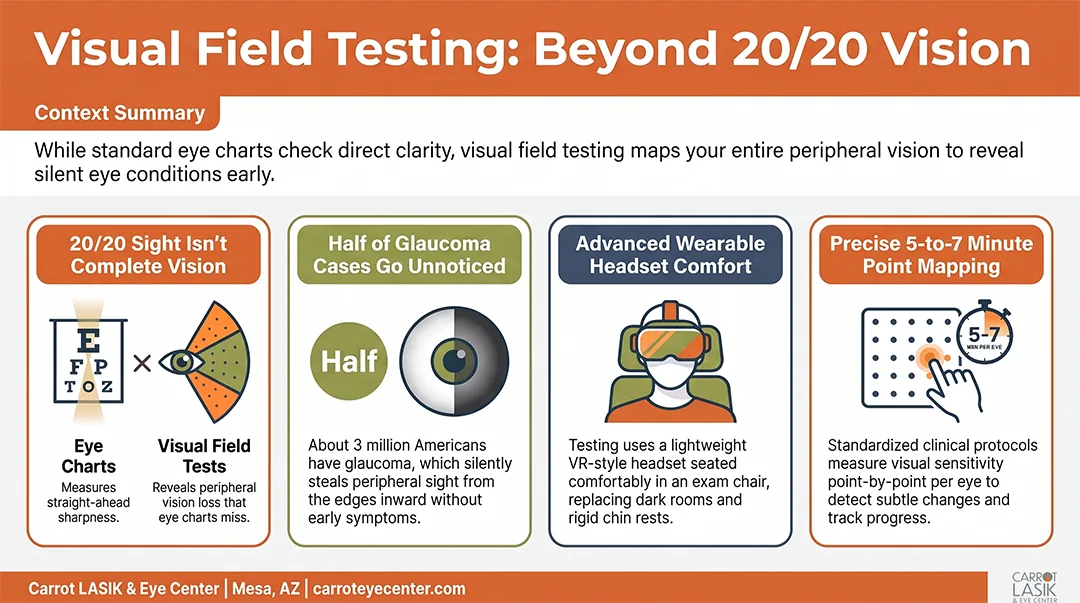
Eye Chart vs. Visual Field Test: What’s the Difference?
An eye chart and a visual field test measure two different things. The eye chart at Carrot LASIK & Eye Center measures visual acuity, or how clearly you see what’s directly in front of you. A visual field test measures where you can see while looking straight ahead. You can score perfectly on one and still have an abnormality on the other.
| Standard Eye Chart | Visual Field Test | |
|---|---|---|
| What it measures | Visual acuity (sharpness and clarity) | The full area of vision, central and peripheral |
| The question it answers | “How clearly can you see what’s directly ahead?” | “Where can you see while looking straight ahead?” |
| What it can miss | Blind spots and peripheral vision loss | Refractive error (your glasses prescription) |
| Commonly related to | Glasses, contacts, LASIK candidacy | Glaucoma, optic nerve, retinal & neurological conditions |
That’s why someone can read the 20/20 line and still have an area of vision loss they’ve never noticed. The two tests together tell a much more complete story than either one alone.
Who Needs a Visual Field Test?
A visual field test at Carrot LASIK & Eye Center is ordered by your doctor when it’s medically indicated. Common reasons a patient in Mesa may need one include:
- Glaucoma or glaucoma suspicion, including elevated eye pressure, a suspicious-looking optic nerve, or a strong family history
- Monitoring diagnosed glaucoma to track whether treatment is holding the disease stable
- High-risk medications, such as long-term hydroxychloroquine (Plaquenil), which requires periodic visual field monitoring to protect the retina
- Optic nerve or neurological concerns, including unexplained vision changes, after a stroke, or when evaluating certain headaches
- Eyelid evaluations, where a drooping lid may be blocking part of the visual field
If your doctor orders a visual field test, it does not mean you have glaucoma or any other disease. It means your doctor wants objective information about how your visual field is functioning, either to rule a problem out, to establish a baseline for comparison over time, or to monitor a known condition.
What Are the 24-2, 10-2, and 30-2 Visual Field Tests?
The visual field tests performed at Carrot LASIK & Eye Center in Mesa are full threshold examinations, primarily the 24-2, 10-2, and 30-2 protocols, run on the Carrot wearable headset. These are the same standardized test patterns used in ophthalmology worldwide, so results are directly comparable and clinically trusted.
The names are simpler than they look. The first number describes how far from your central point of focus the test measures:
- 24-2: tests the central 24 degrees of vision. This is the workhorse examination for glaucoma evaluation and monitoring.
- 30-2: tests the central 30 degrees, adding an outer ring of points beyond the 24-2 pattern.
- 10-2: concentrates many test points within the central 10 degrees, providing fine detail where your sharpest vision lives. It’s commonly used for macula-involving conditions and for hydroxychloroquine (Plaquenil) monitoring.
These are threshold tests, meaning they don’t just check whether you see a target; they measure how sensitive your vision is at each point. That precision is what allows your doctor to detect early or subtle field loss and to compare results from visit to visit.
And if you’ve taken visual field tests before on a traditional machine, there’s a practical reassurance: the Carrot platform reports results in the same standardized format ophthalmology has used for decades, with values benchmarked to the Humphrey perimeter that has long been the industry standard. Your doctor can compare your new results directly against older ones, even tests performed at another practice.
Your doctor selects the protocol based on what question needs answering.
How Long Does a Visual Field Test Take?
A threshold visual field test at Carrot LASIK & Eye Center typically takes 5 to 7 minutes per eye, or 10 to 15 minutes for both eyes. Each eye is tested separately while the other is occluded.
The test takes that long for a good reason: rather than a quick pass, a threshold examination carefully measures visual sensitivity at dozens of individual points, repeating and refining measurements to build a precise map. That detail is exactly what makes the results useful for detecting early loss and tracking change over time.
The headset format helps here too. Because you’re seated comfortably rather than braced against a chin rest, the minutes pass more easily, and staying relaxed during the test supports more reliable results.
Is This a Virtual Reality Eye Exam? What the Carrot Headset Is Like
Yes. Visual field testing at Carrot LASIK & Eye Center is performed through a virtual-reality-style headset rather than a traditional tabletop perimeter. The American Academy of Ophthalmology has described head-mounted, VR-based perimetry as a newer approach to visual field testing that replaces the classic bowl-style machine with a wearable display.
For patients, the practical differences are the point:
| Traditional Tabletop Perimeter | Carrot Headset | |
|---|---|---|
| Setup | Darkened room, chin rest, fixed head position | Lightweight headset (~1.5 lbs), seated comfortably in the exam chair |
| Environment | Room lighting must be controlled | Headset seals out ambient light with its own calibrated environment |
| Guidance | Technician-directed | Built-in audio and visual instructions guide you through the test |
| Protocols | 24-2, 10-2, 30-2 | The same standardized 24-2, 10-2, and 30-2 |
You’ll look into the headset, focus where instructed, and respond whenever you see a target. No chin rest, no awkward posture. That matters for comfort over a 10-to-15-minute test, and especially for older patients and anyone with neck, back, or mobility limitations.
What Can a Visual Field Test Show?
A threshold visual field test at Carrot LASIK & Eye Center produces a detailed sensitivity map of your vision, showing your doctor where your visual field is normal, where sensitivity is reduced, and where defects exist. Because threshold testing is precise, it can reveal early or subtle loss, including changes you haven’t noticed and couldn’t feel.
Just as importantly, repeated tests can be compared over time. For a glaucoma patient, the difference between a stable field and a slowly worsening one is the difference between staying the course and changing treatment. The map from each visit becomes part of that record.
An abnormal result is not, by itself, a diagnosis. Your doctor interprets the visual field alongside the rest of your examination: optic nerve appearance, eye pressure, imaging, your medications, and your history. Field patterns also have characteristic shapes, and the pattern itself (an arcuate defect, a nasal step, central loss) helps point toward or away from specific causes.
How AI Helps Your Doctor Read Visual Field Results
The Carrot platform used at Carrot LASIK & Eye Center includes an AI-based Severity Index that automatically stages 24-2 visual field results as Normal, Mild, Moderate, or Advanced.
The index was built from machine learning analysis of 50,000 reliable visual fields, and its job is narrow and useful: it gives your doctor a standardized reference point when reviewing your results, supporting consistency from test to test and visit to visit.
What it doesn’t do is diagnose. The AI doesn’t decide what your results mean, and it doesn’t replace your doctor’s judgment. Every visual field at Carrot LASIK & Eye Center is interpreted by your ophthalmologist in the context of your full examination. Think of the Severity Index as one more instrument on the panel: helpful, consistent, and always read by a human.
Why Visual Field Loss Is So Hard to Notice on Your Own
Visual field loss usually doesn’t feel like blurry vision, and that’s what makes it dangerous. Vision often remains sharp in one area while another part of the field quietly declines, and the brain is remarkably good at filling in the gaps so you don’t perceive anything missing.
The CDC notes that glaucoma typically has no early symptoms, which is why half of the people who have it don’t know. And with glaucoma, a leading cause of irreversible blindness, vision lost to the disease cannot be restored. Early detection isn’t just helpful; it’s the entire game.
This is why “my vision seems fine” and “my visual field is normal” are not the same statement, and why doctors rely on objective testing rather than waiting for patients to notice symptoms that, by design of the disease, arrive late.
Does a Visual Field Test Diagnose Glaucoma?
No single test diagnoses glaucoma, including a visual field test. Ophthalmologists diagnose glaucoma from a combination of findings, and the visual field is one essential piece of that picture.
A full glaucoma evaluation may include examination of the optic nerve, measurement of eye pressure, imaging of the nerve fiber layer, and threshold visual field testing, depending on the individual patient.
Where visual field testing is irreplaceable is in showing function: pressure readings and imaging show the state of the eye’s structures, but the visual field shows what your vision is actually doing. It’s also the primary way glaucoma is monitored over the years, which is why patients with glaucoma or glaucoma suspicion can expect to repeat this test periodically.
What to Expect at Carrot LASIK & Eye Center
If your doctor at Carrot LASIK & Eye Center orders a visual field test, here’s the short version of what your visit looks like:
- The test is performed in the exam chair using the lightweight Carrot headset, with no dark room or chin rest
- Audio and visual prompts inside the headset guide you through each step
- Each eye is tested separately, about 5 to 7 minutes per eye
- Your doctor reviews the results with you in the context of your full examination
- If monitoring is needed, future tests are compared directly against your baseline
Dr. Matthew Hammond, Dr. Michael Herion, Dr. Kelly Kiser, and the team at Carrot LASIK & Eye Center provide comprehensive ophthalmology and vision correction care in Mesa, serving patients throughout the greater Phoenix area and the East Valley.
Has your doctor recommended a visual field test, or is it time for a comprehensive eye exam? Schedule your visit or call (480) 561-6000.
Frequently Asked Questions About Visual Field Testing
My doctor ordered a visual field test. Does that mean I have glaucoma?
No. A visual field test is ordered for many reasons: to evaluate a suspicious finding, to establish a baseline, to monitor a medication like hydroxychloroquine (Plaquenil), or to track a known condition. Many patients who take the test turn out to have completely normal visual fields. The test exists to answer a question, not to confirm a diagnosis.
Is a visual field test covered by insurance?
When a visual field test is medically indicated, it is typically billed to medical insurance like other diagnostic eye testing. Coverage depends on your plan, and our team can walk you through what to expect before the test is performed.
Do I need to have my eyes dilated for the test?
No. Visual field testing doesn’t require dilation, and it’s typically performed before any dilating drops are used, since dilation can affect the results.
Can I wear my glasses or contact lenses during the test?
The Carrot headset is designed to accommodate patients who need vision correction, and our technicians will set the test up appropriately for you, including refractive correction inside the headset when needed. You don’t need to do anything special to prepare.
Is the headset uncomfortable or claustrophobic?
Most patients find it easier than a traditional visual field machine. The headset is lightweight (about 1.5 pounds), you stay seated normally in the exam chair with no chin rest or fixed head position, and audio prompts guide you through the test from start to finish.
How often will I need a visual field test?
That depends on why it was ordered. Patients being monitored for glaucoma or on high-risk medications may repeat the test periodically, often once or twice a year, at whatever interval your doctor recommends. Because results are recorded digitally, each test is compared directly against your earlier ones to detect change.
What happens if my visual field test is abnormal?
An abnormal result means your doctor will interpret the finding alongside the rest of your examination. Depending on the pattern and your history, next steps may include repeating the test to confirm the result, additional imaging or diagnostics, or adjusting the management of a known condition. An abnormal field alone does not establish a diagnosis.
Where can I get a visual field test in Mesa, Arizona?
Carrot LASIK & Eye Center at 1500 S. Dobson Rd., Suite 313 in Mesa performs headset-based visual field testing when medically indicated, serving patients throughout the greater Phoenix area. Call (480) 561-6000 to schedule.
Key Takeaways
- A visual field test measures something an eye chart can’t: where you can see, not just how clearly. You can have 20/20 acuity and still have visual field loss.
- About 3 million Americans have glaucoma and half don’t know it (CDC), because early visual field loss usually has no symptoms and cannot be reversed once it occurs.
- Carrot LASIK & Eye Center in Mesa performs visual field testing on the Carrot wearable headset: no dark room, no chin rest, with the same trusted 24-2, 10-2, and 30-2 protocols.
- These are threshold examinations that measure sensitivity point by point, taking about 5 to 7 minutes per eye, which is what makes them precise enough to catch early loss and track change over time.
- Your doctor orders the test when it’s medically indicated: glaucoma evaluation or monitoring, high-risk medications like Plaquenil, optic nerve or neurological concerns, or eyelid evaluations.
- Being ordered a visual field test is not a diagnosis, and neither is an abnormal result: findings are always interpreted alongside the full examination.
Medically Reviewed By:
Matthew Hammond, MD
Board-Certified Ophthalmologist
Fellowship Trained Refractive Surgeon, WCRS
Last reviewed on October 13, 2026
from Carrot LASIK & Eye Center https://ift.tt/qZKmSIt
via Carrot LASIK & Eye Center

Comments
Post a Comment