Is EVO ICL Reversible and Safe? What Mesa Patients Should Know
Is EVO ICL Reversible and Safe for Patients in Mesa?
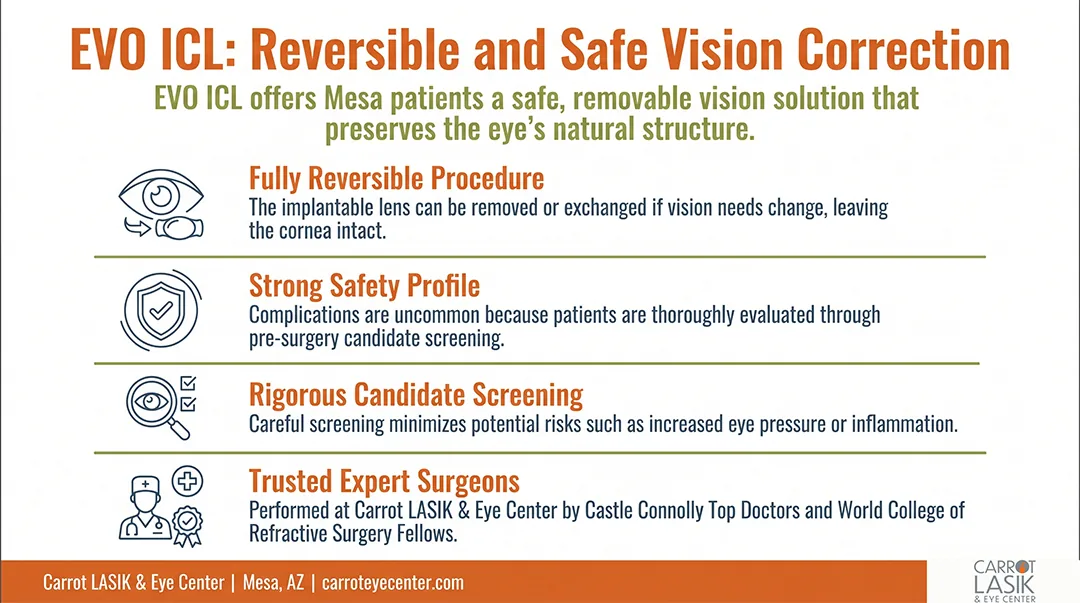
Yes, EVO ICL is reversible, and the procedure has a strong safety record for patients in Mesa who meet candidacy criteria. A surgeon can remove or exchange the implantable collamer lens if vision needs change, because the procedure leaves the cornea and the eye’s natural lens in place. Complications are uncommon. Possible complications include increased eye pressure, inflammation, and the need for additional surgery, so candidates are screened carefully before surgery.
At Carrot LASIK & Eye Center, a veteran-owned practice in Mesa, EVO ICL is performed by Matthew Hammond, M.D., Michael Herion, M.D., and Kelly Kiser, M.D. Dr. Hammond and Dr. Herion both served in the U.S. military and are Castle Connolly Top Doctors, and all three are Fellows of the World College of Refractive Surgery.
Why Would a Mesa Surgeon Remove or Exchange an EVO ICL?
EVO ICL is designed to be removable, so a Mesa surgeon can take it out during cataract surgery later in life or update it if newer lens technology becomes available. Both reflect long-term planning. Removal or exchange for lens fit or a result that differs from the planned correction is rare, because pre-surgical measurements are designed to prevent both. When an exchange is needed, it uses a small incision.
At Carrot LASIK & Eye Center in Mesa, the eye measurements used to size an EVO ICL are taken during the consultation. The operating surgeon, whether Matthew Hammond, M.D., Michael Herion, M.D., or Kelly Kiser, M.D., meets each patient before and after surgery.
What Are the Possible Complications of EVO ICL Surgery in Mesa?
Possible complications of EVO ICL surgery include increased eye pressure, inflammation, cataract, glare or halos, and gradual loss of cells from the cornea’s inner surface. A second procedure to reposition, replace, or remove the lens is sometimes needed. These complications are uncommon. Because EVO ICL is surgery inside the eye, infection is a rare risk, and follow-up exams in Mesa monitor eye pressure and corneal cell health.
Carrot LASIK & Eye Center holds Joint Commission National Quality Approval and operates as a full-service ophthalmology practice in Mesa, with glaucoma management and retina care under one roof. Follow-up care after EVO ICL, including eye pressure monitoring, stays within the same practice.
What Happens to an EVO ICL If a Mesa Patient Develops Cataracts Later?
If a Mesa patient develops a cataract after EVO ICL, the surgeon typically removes the ICL and performs cataract surgery. Both often happen in the same operation. Because EVO ICL leaves the cornea unchanged, it does not complicate the lens measurements used to plan future cataract surgery, as laser procedures that reshape the cornea can. Published studies of combined ICL removal and cataract surgery report good safety and visual outcomes.
Carrot LASIK & Eye Center performs laser-assisted premium cataract surgery in Mesa, so a patient who has EVO ICL at the practice can have the lens removed and cataract surgery performed later by the same surgical team. Future eye care stays with one practice rather than starting over elsewhere.
Does Removing an EVO ICL Harm the Eye or Long-Term Vision for Mesa Patients?
For Mesa patients, removing an EVO ICL generally returns the eye to its original prescription, because the cornea and natural lens were left in place. Removal is a second surgery inside the eye, so it carries risks similar to the first procedure, including inflammation, eye pressure changes, and loss of corneal cells. Published case series report few complications.
Matthew Hammond, M.D., and Michael Herion, M.D., both had vision correction surgery at Carrot LASIK & Eye Center, where Kelly Kiser, M.D., also performs EVO ICL. Removal and exchange are reviewed during every EVO ICL consultation in Mesa, so patients understand their future options before choosing the lens.
Is EVO ICL FDA Approved, and How Long Has It Been Available to Mesa Patients?
Yes, the FDA approved EVO ICL in March 2022, and the earlier Visian ICL design it builds on has held FDA approval since 2005. EVO ICL entered international use in 2011. As of 2026, EVO ICL remains FDA-approved in the United States for nearsightedness with or without astigmatism. A central port in the lens lets fluid flow through, so Mesa patients don’t need a laser opening in the iris beforehand.
Matthew Hammond, M.D., previously served as Director of Warfighter Refractive Surgery at Landstuhl Regional Medical Center in Germany and published a peer-reviewed study of refractive surgery in 16,111 Army service members in the journal Ophthalmology. He now brings that experience to Mesa patients at Carrot LASIK & Eye Center, alongside Michael Herion, M.D., and Kelly Kiser, M.D.
Are EVO ICL Surgeons in Mesa Certified by the Lens Manufacturer?
Yes, STAAR Surgical, the company that manufactures EVO ICL, requires every surgeon to complete its certification program before ordering EVO lenses. That includes every EVO surgeon in Mesa. Certification includes online training, hands-on wet labs, and proctored surgery covering lens sizing, ordering, and surgical technique.
EVO ICL at Carrot LASIK & Eye Center in Mesa is performed by Matthew Hammond, M.D., Michael Herion, M.D., and Kelly Kiser, M.D. All three surgeons are board-certified by the American Board of Ophthalmology, and Dr. Hammond is a member of the American Society of Cataract and Refractive Surgery.
How Does EVO ICL Safety Compare to LASIK for Mesa Patients?
For Mesa patients, EVO ICL and LASIK are both FDA-approved with established safety records, and their risks differ mainly by location in the eye. LASIK reshapes the cornea, so its main risks involve dry eye and the corneal flap. EVO ICL leaves the cornea untouched, so its main risks are inside the eye, including increased eye pressure, cataract, and loss of corneal cells. Eye measurements decide which profile fits.
Carrot LASIK & Eye Center offers six modern vision correction procedures under one roof in Mesa, including LASIK, SMILE, PRK, and EVO ICL, so Matthew Hammond, M.D., Michael Herion, M.D., and Kelly Kiser, M.D., can match the procedure to each patient’s corneal measurements and prescription rather than to a single specialty.
Candidacy for high prescriptions and EVO ICL cost are covered in the guide to EVO ICL for high prescriptions in Mesa.
Key Takeaways: EVO ICL Reversibility and Safety in Mesa
- EVO ICL is reversible for Mesa patients: a surgeon can remove or exchange the lens, since the cornea and natural lens stay in place.
- Because EVO ICL is removable, Mesa surgeons can take it out during cataract surgery or update it if new technology becomes available, and exchange for lens fit is rare.
- Possible EVO ICL complications include increased eye pressure, inflammation, corneal cell loss, cataract, and additional surgery, and they are uncommon.
- The FDA approved EVO ICL in March 2022, and STAAR Surgical requires every EVO ICL surgeon to complete its certification program.
- Three World College of Refractive Surgery Fellows, Matthew Hammond, M.D., Michael Herion, M.D., and Kelly Kiser, M.D., perform EVO ICL at Carrot LASIK & Eye Center in Mesa.
Communities Served
Carrot LASIK & Eye Center is located at 1500 S Dobson Road, Suite 313, in Mesa, Arizona. Patients come for EVO ICL from Mesa, Scottsdale, Tempe, Chandler, Gilbert, and across the Phoenix metro.
EVO ICL consultations at Carrot LASIK & Eye Center include measurements of the eye’s internal anatomy and a review of future removal and exchange options. Schedule a consultation in Mesa to learn whether EVO ICL fits your eyes.
Medically Reviewed By:
Kelly Kiser, MD
Board-Certified Ophthalmologist
Fellowship Trained Refractive Surgeon, WCRS
Last reviewed on October 16, 2026
from Carrot LASIK & Eye Center https://ift.tt/y9XKgcP
via Carrot LASIK & Eye Center

Comments
Post a Comment