Is LASIK or Refractive Lens Exchange (RLE) the Better Choice for You?
Two procedures dominate the vision correction conversation for adults whose eyes have started to change, and they work on entirely different parts of the eye. Which one a surgeon recommends turns on a question most patients have never been asked.
Is LASIK or Refractive Lens Exchange (RLE) the better choice for me?
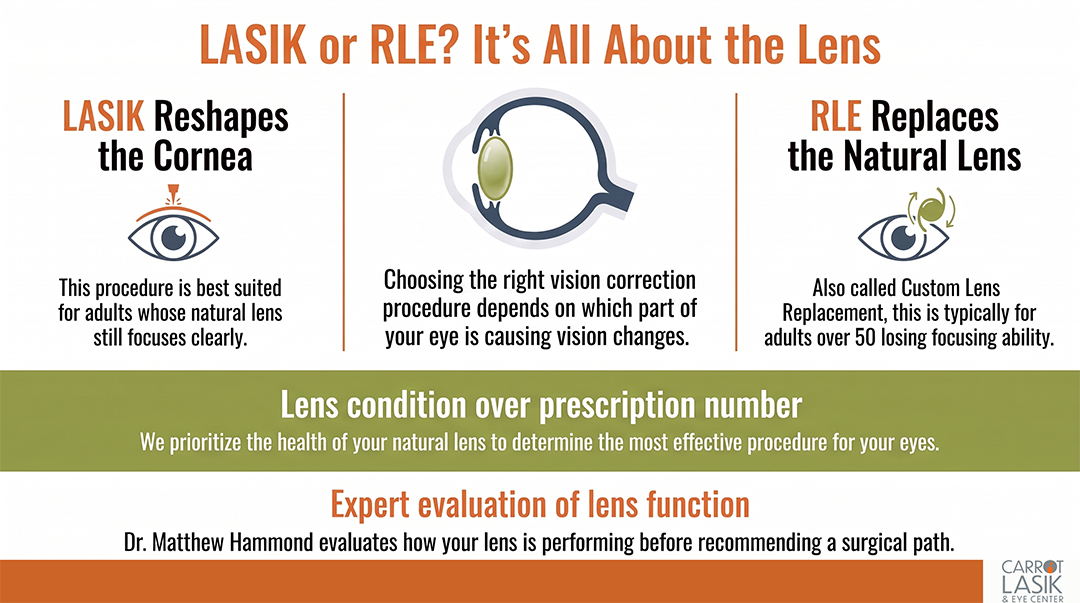
The choice between LASIK and Refractive Lens Exchange depends primarily on which part of the eye is causing the vision problem. LASIK reshapes the cornea and suits adults whose natural lens still focuses clearly. Refractive Lens Exchange (RLE), also called Custom Lens Replacement, replaces the eye’s natural lens and is generally considered for adults over 50 whose lens has begun losing focusing ability. Prescription type also shapes which procedure a surgeon recommends.
Matthew Hammond, M.D., board-certified ophthalmologist, Fellow of the World College of Refractive Surgery, and co-founder of Carrot LASIK & Eye Center, evaluates what the natural lens is doing before recommending LASIK or a lens-based procedure. At Carrot, the determining factor is the condition of the lens, not the prescription number alone.
At what age do Mesa surgeons typically recommend RLE over LASIK?
There is no single age at which Refractive Lens Exchange replaces LASIK. RLE is generally considered for patients over 50, but the practical threshold differs by prescription. Farsighted patients developing presbyopia are often considered candidates earlier, while nearsighted patients are typically considered later, because lens-based surgery carries higher retinal risk in younger, more nearsighted eyes. As of 2026, Mesa surgeons evaluate age alongside lens condition.
At Carrot LASIK & Eye Center, candidacy is determined through a Mesa consultation that measures the cornea and evaluates the natural lens, rather than by age alone. Carrot offers seven modern vision correction procedures under one roof, so the recommendation follows the eye.
Can LASIK correct age-related reading vision, or is RLE needed for that?
LASIK does not stop age-related reading difficulty. LASIK reshapes the cornea to correct distance vision, while presbyopia, the gradual loss of near focus that develops in adults beginning in their mid-40s, comes from the eye’s natural lens becoming less flexible. Presbyopia continues on the same timeline after LASIK. Refractive Lens Exchange addresses the lens itself, and Blended Vision offers a separate corneal approach to near vision.
Is RLE a better option than LASIK for Mesa patients over 40?
Age alone does not determine whether Refractive Lens Exchange suits a patient better than LASIK. Surgeons in Mesa weigh the clarity and flexibility of the natural lens, the type and strength of the prescription, corneal thickness and shape, and the patient’s daily visual goals. Patients whose corneas remain suitable and whose natural lens still focuses well often remain LASIK candidates well past 40.
Carrot LASIK & Eye Center evaluates both pathways in the same Mesa visit. Because Carrot is not a single-procedure practice, patients are matched to the procedure their eyes support rather than to the only option on offer, and Refractive Lens Exchange is weighed against LASIK in the same exam.
How long-lasting are RLE results compared to LASIK as my eyes age?
Refractive Lens Exchange and LASIK hold their results differently. The lens implanted during RLE does not change shape or clarity as a patient ages, so the correction it provides is long-lasting. LASIK reshapes the cornea in a way that cannot be undone, but the eye’s natural lens remains in place and continues to age underneath, which can change vision over time, most commonly through presbyopia and later cataract development.
How do the costs of LASIK and RLE compare in Mesa?
Refractive Lens Exchange generally costs more than LASIK in Mesa because it is an intraocular procedure that includes a lens implant selected specifically for each patient. Vision and medical insurance typically do not cover either procedure when performed to correct vision rather than to treat a medical condition. Final cost depends on the procedure chosen and, for RLE, the type of lens implanted.
Carrot LASIK & Eye Center reviews cost during the Mesa consultation and provides all-inclusive pricing with no hidden fees. Financing options are available, and lens selection is discussed before a quote is finalized.
Does RLE also address future cataracts in a way LASIK does not?
Yes. Because Refractive Lens Exchange removes the eye’s natural lens, the structure in which cataracts form, a cataract cannot later develop in that lens. LASIK does not alter the natural lens, so patients who have LASIK can still develop cataracts and may need cataract surgery later in life. The capsule holding the implanted lens can cloud over time, a condition treated with a brief in-office laser procedure.
Kelly Kiser, M.D., board-certified ophthalmologist and Fellow of the World College of Refractive Surgery at Carrot LASIK & Eye Center, treats the cataract question as a long-term factor patients weigh when comparing the two procedures.
If I’m too old for LASIK, do Mesa practices offer RLE as an alternative?
Age by itself rarely disqualifies someone from LASIK. What changes with age is whether LASIK addresses the actual cause of the vision problem, since once the natural lens begins losing clarity or focusing ability, reshaping the cornea may not deliver the result a patient wants. As of 2026, Mesa practices evaluate Refractive Lens Exchange as one of several alternatives when LASIK is not the appropriate procedure.
Dr. Hammond and Dr. Herion are Fellows of the World College of Refractive Surgery and 2026 Castle Connolly Top Doctors who have each undergone vision correction surgery at Carrot LASIK & Eye Center. Both surgeons personally meet Mesa patients before and after surgery and review how age affects LASIK candidacy alongside the full set of alternatives to LASIK.
Key Takeaways: LASIK vs. Refractive Lens Exchange in Mesa
- LASIK reshapes the cornea while Refractive Lens Exchange replaces the eye’s natural lens, and the determining factor is which structure causes the vision problem.
- There is no single age at which RLE replaces LASIK in Mesa; the practical threshold differs by prescription type.
- LASIK does not stop presbyopia, which develops as the natural lens loses flexibility and continues on the same timeline after surgery.
- Because RLE removes the lens in which cataracts form, a cataract cannot later develop in that lens.
- Mesa patients who are not LASIK candidates are evaluated for RLE and other vision correction procedures at Carrot LASIK & Eye Center.
A consultation at Carrot LASIK & Eye Center in Mesa measures the cornea and evaluates the natural lens to determine whether LASIK, Refractive Lens Exchange, or another procedure fits your eyes.
Medically Reviewed By:
Michael Herion, MD
Board-Certified Ophthalmologist
Fellowship Trained Refractive Surgeon, WCRS
Last reviewed on August 31, 2026
from Carrot LASIK & Eye Center https://ift.tt/uIBzJlP
via Carrot LASIK & Eye Center

Comments
Post a Comment