How to Find a Good LASIK Surgeon in Gilbert, AZ
Choosing a LASIK surgeon comes down to a few specific details that can be verified before booking an appointment. Knowing which factors matter, and where each one can be confirmed, is what separates an informed decision from a guess.
How do you find a good LASIK surgeon in Gilbert, AZ?
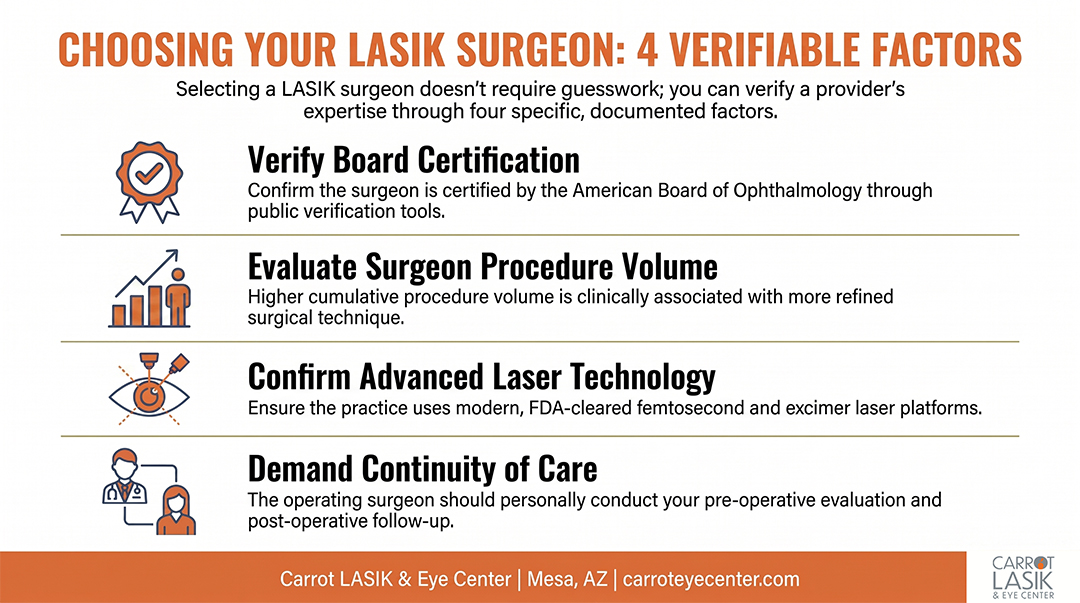
A qualified LASIK surgeon can be identified through four verifiable factors: board certification in ophthalmology, documented refractive-procedure volume, the generation of laser technology the practice uses, and whether the operating surgeon personally manages pre- and post-operative care. None of this requires guesswork. Each factor is confirmable before scheduling, through state medical-board records, the practice’s disclosed case numbers, and the consultation itself.
Board Certification and Credentials: What to Look For
Board certification from the American Board of Ophthalmology is the core credential for a LASIK surgeon. It confirms an accredited residency and ongoing competency assessment. Fellowship training in refractive or corneal surgery signals subspecialty focus beyond residency. These are earned certifications that reflect the standardized education, examination, and continuing-education requirements set by the certifying body.
Verification is straightforward. Board certification can be checked through the American Board of Ophthalmology’s public physician-verification tool and the state medical board where the surgeon practices; both list active status and any disciplinary history. Fellowship training and hospital affiliations can be confirmed through the practice’s own disclosures and, where applicable, the training institution or professional-society records.
Surgeon Experience and Procedure Volume
Refractive-surgery experience is commonly evaluated two ways: the number of procedures a surgeon has performed, and the number of years in active practice. Higher cumulative volume is associated with refined technique in the published literature. There is no universal minimum. Rather than chase a single number, prospective patients can ask a surgeon to disclose their approximate case volume and how long they have performed LASIK specifically.
Laser Technology and Platforms
LASIK relies on two laser systems. A femtosecond laser creates the corneal flap (or, in flapless techniques, shapes a lenticule), and an excimer laser reshapes the cornea itself. As of 2026, FDA-cleared femtosecond platforms include the ZEISS VisuMax, which also performs the flapless SMILE procedure. The generation and upkeep of a practice’s lasers can be confirmed during the consultation.
Questions to Ask at a LASIK Consultation
A LASIK consultation is where candidacy and the surgeon’s approach can be confirmed directly. Useful questions to bring include:
- Who performs the surgery, and who manages the follow-up care?
- What is the surgeon’s approximate LASIK case volume and complication rate?
- Which laser platforms are used, and are they FDA-cleared for the patient’s prescription?
- What factors would make someone ineligible for LASIK?
The Surgeon’s Own Experience and Continuity of Care
Whether a surgeon has personally undergone LASIK is one signal of confidence in the procedure, though it is not a clinical qualification on its own. A surgeon who has had refractive surgery can speak to the patient experience firsthand. This factor is best weighed alongside verifiable credentials, case volume, and technology, rather than in place of them.
Continuity of care means the same surgeon who performs the LASIK procedure also conducts the pre-operative evaluation and post-operative follow-up. Consistency matters here. It lets the operating surgeon track healing against the original surgical plan and respond directly to any changes. Patients can confirm at the consultation whether the operating surgeon will personally manage follow-up visits, or whether that care is delegated.
Key Takeaways: Choosing a LASIK Surgeon
- Board certification from the American Board of Ophthalmology confirms a LASIK surgeon completed accredited residency training and ongoing competency assessment.
- Certification status and disciplinary history can be verified through the American Board of Ophthalmology’s public tool and the state medical board.
- LASIK uses a femtosecond laser for flap or lenticule creation and an excimer laser to reshape the cornea; FDA-cleared platforms include the ZEISS VisuMax.
- Continuity of care — the operating surgeon also managing pre- and post-operative visits — lets the surgeon track healing against the original surgical plan.
- A consultation is the point at which candidacy, case volume, laser platforms, and who performs surgery and follow-up can be confirmed directly.
LASIK Surgeons Serving Gilbert
Carrot LASIK & Eye Center serves Gilbert and the East Valley from its Mesa office, a short drive away. The practice is led by two Fellows of the World College of Refractive Surgery — Matthew Hammond, M.D. and Michael Herion, M.D. — both board-certified ophthalmologists, both Castle Connolly Top Doctors, and both military-trained veterans who have personally undergone vision correction surgery. At Carrot, the surgeon who performs the procedure also manages the patient’s pre- and post-operative care.
Schedule a LASIK consultation at Carrot LASIK & Eye Center to find out whether you’re a candidate — serving Gilbert and the East Valley from nearby Mesa.
Related Resources
Frequently Asked Questions
What credentials should a LASIK surgeon have?
Board certification from the American Board of Ophthalmology is the core credential, confirming accredited residency training and continuing competency review. Fellowship training in refractive or corneal surgery signals added subspecialty focus.
How do you verify a LASIK surgeon’s credentials?
Certification and any disciplinary record can be checked through the American Board of Ophthalmology’s online verification tool and the state medical board where the surgeon is licensed.
How much experience should a LASIK surgeon have?
Experience is measured by years in active refractive practice and cumulative procedure volume. Prospective patients can ask a surgeon to disclose their approximate LASIK case count rather than relying on a fixed threshold.
What questions should you ask at a LASIK consultation?
Ask who performs the surgery and manages follow-up, the surgeon’s approximate case volume and complication rate, which FDA-cleared laser platforms are used, and what factors would make someone ineligible.
What laser technology is used for LASIK?
LASIK combines a femtosecond laser for flap or lenticule creation with an excimer laser to reshape the cornea. FDA-cleared femtosecond systems include the ZEISS VisuMax, also used for the flapless SMILE procedure.
Should you choose a LASIK surgeon who has had the procedure?
A surgeon who has personally had LASIK can speak to the experience firsthand, which some patients find reassuring. It is one signal of confidence, best considered alongside credentials, volume, and technology rather than on its own.
Does the same surgeon perform LASIK and follow-up care?
This varies by practice. Continuity — the operating surgeon also handling pre- and post-operative visits — lets that surgeon monitor healing against the original plan, and can be confirmed at the consultation.
Medically Reviewed By:
Michael Herion, MD
Board-Certified Ophthalmologist
Fellowship Trained Refractive Surgeon, WCRS
Last reviewed on July 8, 2026
from Carrot LASIK & Eye Center https://ift.tt/9apjWym
via Carrot LASIK & Eye Center

Comments
Post a Comment