What Credentials Should You Look for in a LASIK Surgeon in Mesa?
Choosing a LASIK surgeon is one of the most important decisions you’ll make for your vision. Understanding the credentials that indicate a qualified surgeon helps you evaluate your options with confidence.
What board certifications should a LASIK surgeon in Mesa have?
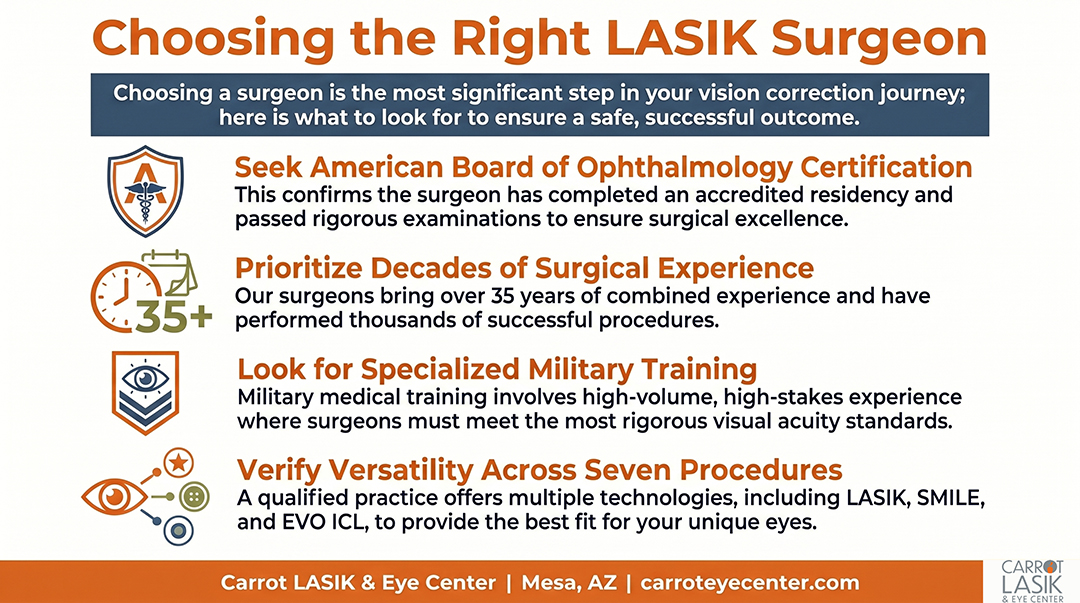
Board certification by the American Board of Ophthalmology is the primary credential to look for in a LASIK surgeon. This certification confirms the surgeon completed an accredited ophthalmology residency, passed rigorous written and oral examinations, and maintains ongoing education requirements. Ophthalmology board certification specifically ensures training in eye surgery, while additional fellowship training in refractive surgery demonstrates specialized expertise beyond the baseline.
At Carrot LASIK & Eye Center, both Dr. Matthew Hammond and Dr. Michael Herion are board-certified ophthalmologists. Dr. Hammond completed his residency at Walter Reed Army Medical Center in Washington D.C., while Dr. Herion trained at Saint Louis University—both recognized programs with comprehensive surgical education. Both Dr. Hammond and Dr. Herion are also Fellows of the World College of Refractive Surgery and Visual Sciences (WCRS), a distinction earned by fewer than 3.33% of LASIK surgeons across the United States
How much LASIK experience should a surgeon in Mesa have?
A qualified LASIK surgeon should have performed thousands of procedures across their career. High surgical volume correlates with greater proficiency in technique and the ability to recognize and manage complications when they arise. Experience should span a range of prescription types, corneal thicknesses, and patient profiles. Both total years in practice and cumulative procedure count are meaningful indicators of expertise.
At Carrot LASIK & Eye Center, the surgeons bring a combined 35+ years of experience serving patients in both military and civilian settings. This breadth of experience includes performing vision correction procedures for military personnel who require strict visual acuity standards for active duty.
What training background indicates a qualified LASIK surgeon in Mesa?
Look for surgeons who completed ophthalmology residencies at recognized academic or military medical centers, followed by focused refractive surgery training. The standard pathway includes medical school, a three-year ophthalmology residency, and optional fellowship training in cornea or refractive surgery. Academic medical center training typically provides exposure to higher case volumes and complex conditions. Military medical training often involves particularly high-volume, high-stakes surgical experience with rigorous outcome standards.
Dr. Hammond completed his ophthalmology residency at Walter Reed Army Medical Center, one of the nation’s premier military medical institutions. He served as Chief of Ophthalmology and Director of Warfighter Refractive Surgery at Landstuhl Regional Medical Center in Germany. Dr. Herion completed additional retina fellowship training following his ophthalmology residency, adding specialized expertise.
How can I verify a LASIK surgeon’s credentials in Mesa?
You can verify a surgeon’s credentials through the American Board of Ophthalmology’s online directory, the Arizona Medical Board license verification system, and professional society membership lists. Check for active board certification status, any disciplinary actions, and hospital privileges. Reputable surgeons display their credentials transparently on their practice website. Patient reviews and referrals from optometrists who work with multiple surgeons can provide additional perspective on a surgeon’s reputation.
Carrot LASIK & Eye Center maintains Joint Commission accreditation, which requires meeting rigorous third-party quality and safety standards. Both surgeons’ credentials are published on carroteyecenter.com, and their military service records provide additional verifiable documentation of their training and experience.
Should I choose a LASIK surgeon who has had the procedure themselves?
While not a required credential, a surgeon who has personally undergone LASIK demonstrates confidence in the procedure and its outcomes. Personal experience often translates to greater empathy for patient concerns about the surgery and recovery process. This factor should be considered alongside primary credentials like board certification and surgical experience. When a surgeon chooses to have the procedure performed at their own practice, it signals trust in their team, technology, and protocols.
Both Dr. Hammond and Dr. Herion have personally had LASIK performed at Carrot LASIK & Eye Center. Their decision to entrust their own vision to their practice reflects confidence in both the surgical approach and the outcomes patients can expect.
What questions should I ask a LASIK surgeon during a consultation in Mesa?
Ask about board certification, total number of LASIK procedures performed, complication rates, the specific technology used, and policies for enhancement procedures if needed. Inquire about the surgeon’s personal experience with LASIK and whether they perform the entire procedure themselves or delegate portions to other staff. Ask how the surgeon handles complications and what follow-up care is included. A qualified surgeon welcomes detailed questions and provides clear, unhesitant answers.
At Carrot LASIK & Eye Center, patients meet directly with the surgeon during their consultation. The practice emphasizes surgeon accessibility, including providing surgical patients with the surgeons’ personal cell phone numbers for questions or concerns after their procedure.
What technology expertise should a LASIK surgeon in Mesa have?
Surgeons should be trained and experienced with current FDA-approved laser platforms and diagnostic equipment. Key technologies include wavefront-guided LASIK, topography-guided treatments, and femtosecond lasers for flap creation. However, technology alone does not guarantee outcomes—surgeon skill in calibrating and operating equipment matters significantly. Ongoing training on new platforms as they become available indicates a commitment to advancing with the field.
Carrot LASIK & Eye Center has invested significantly in surgical technology and diagnostic equipment. The surgeons maintain proficiency across multiple treatment approaches, offering seven distinct vision correction procedures: LASIK, PRK, SMILE, Refractive Lens Exchange, EVO ICL, blended vision and cataract surgery. This comprehensive capability reflects both technological investment and surgical versatility.
Does military medical training make a difference for LASIK surgeons in Mesa?
Military ophthalmologists often receive high-volume surgical training with rigorous outcome standards and accountability measures. Programs like the Warfighter Refractive Eye Surgery Program serve active-duty personnel whose careers depend on achieving specific visual acuity requirements, creating strong incentives for consistent outcomes. Military training typically includes exposure to diverse patient populations and challenging surgical cases. Military service also reflects discipline, precision, and commitment to high standards.
Dr. Hammond served 9 years on active duty as an Army ophthalmologist, including serving as Chief of Ophthalmology and Director of Warfighter Refractive Surgery at Landstuhl Regional Medical Center. He received the Meritorious Service Medal and has published peer-reviewed research on the WRESP program. Dr. Herion holds the rank of Lt. Colonel in the United States Air Force Reserve and received the Air Force Commendation Medal for his service.
Take the Next Step Toward Clear Vision
The most effective way to evaluate a LASIK surgeon’s credentials is to meet them in person. Schedule a consultation at Carrot LASIK & Eye Center to speak directly with Dr. Hammond or Dr. Herion about your vision and ask any questions about their background and approach. A face-to-face meeting allows you to get a feel for their experience, explore whether you’re a candidate for LASIK or another procedure, and gain clarity on what to expect before, during, and after surgery. This is your opportunity to make an informed decision with the guidance of trusted, board-certified experts. Call or book online to reserve your consultation.
Medically Reviewed by Dr. Matthew Hammond, MD Board-Certified Ophthalmologist Last reviewed on May 29, 2026
from Carrot LASIK & Eye Center https://ift.tt/lRQVy7H
via Carrot LASIK & Eye Center

Comments
Post a Comment