Why LASIK Isn’t Your Only Option: How EVO ICL Works Differently (And Why That Matters for Your Eyes)
When it comes to refractive surgery, most people have heard one name: LASIK. It dominates the conversation for good reason — it has decades of clinical data behind it and millions of satisfied patients. At Carrot LASIK & Eye Center, LASIK is a procedure we perform regularly and believe in. But it’s also one of six vision correction options we offer, because we don’t believe every patient should default to the same solution. EVO ICL is a fundamentally different approach to vision correction — one that’s worth understanding before you make any decision about your eyes.
How LASIK Actually Works
LASIK — laser-assisted in situ keratomileusis — corrects vision by using a laser to reshape the cornea. The cornea is the clear, dome-shaped tissue at the front of the eye that plays a primary role in refraction, bending light so it focuses precisely on the retina. When the cornea’s shape is irregular due to near-sightedness (myopia), astigmatism, or other refractive errors, visual acuity suffers.
During LASIK surgery, a surgeon creates a thin flap in the outer layer of the cornea, then uses a laser to remove precise amounts of corneal tissue underneath. Reshaping the cornea changes how light enters the eye, improving visual perception without the ongoing need for glasses or a contact lens. The procedure is fast, well-established, and effective for most patients whose corneas meet certain thickness requirements and whose eyeglass prescription falls within the approved treatment range. During a consultation, we assess whether a patient’s anatomy makes them a strong fit for LASIK — and sometimes, the evaluation points somewhere else.
How EVO ICL Works — A Different Approach Entirely
EVO ICL (Implantable Collamer® Lens) belongs to a category of ophthalmology known as phakic intraocular lens surgery. Rather than altering the cornea, EVO ICL works by adding a corrective lens inside the eye — specifically, in the space between the iris and the eye’s natural crystalline lens. At Carrot LASIK & Eye Center, we offer EVO ICL as a primary vision correction option. We perform a thorough pre-surgical evaluation to determine which procedure best fits each individual.
The EVO ICL implant is made from Collamer, a material developed specifically for intraocular use. Its biocompatibility means the eye does not recognize it as a foreign object, and it functions in harmony with the eye’s natural structures. Built into the lens is protection against ultraviolet light, blocking UV rays that can contribute to long-term eye damage — with no additional effort required from the patient.
A surgeon makes a small incision, folds the flexible intraocular lens, inserts it, and positions it precisely behind the iris. The procedure typically takes under 30 minutes per eye, and most patients report noticeably improved visual acuity within the first day of healing.
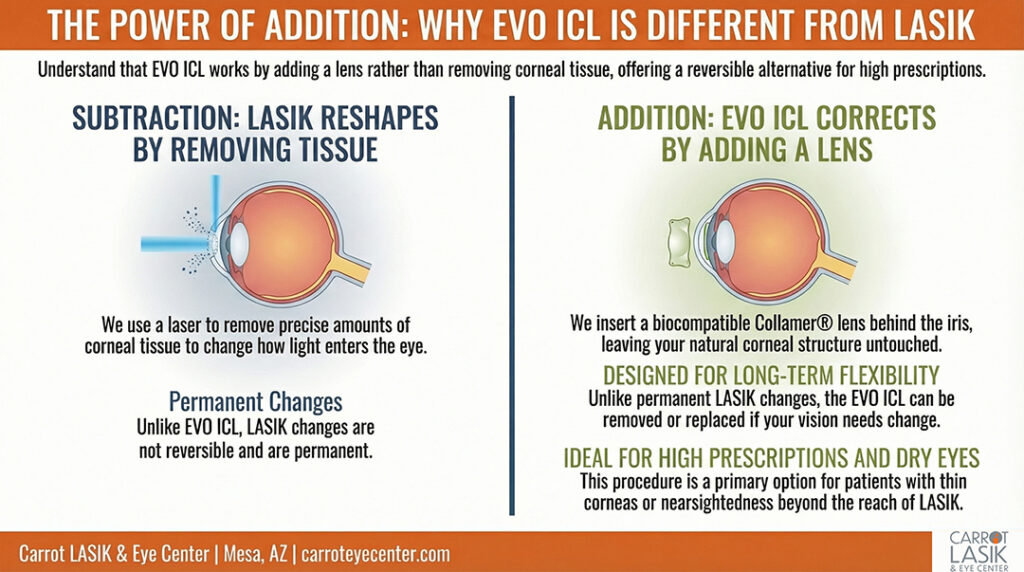
The Core Distinction: Addition vs. Subtraction
This is the conceptual difference that matters most. LASIK works by permanently removing corneal tissue to change how the eye handles refraction. EVO ICL works by adding a phakic intraocular lens without disturbing the cornea at all.
Think of it this way: LASIK reshapes the surface of the eye to correct how light enters. EVO ICL inserts a precision corrective lens in front of the eye’s natural one — similar in concept to placing a prescription insert inside a windshield rather than grinding down the glass itself.
The practical implications of this distinction are significant. Because no tissue is removed, the procedure offers flexibility that LASIK cannot. If a patient’s vision changes substantially over time, or if future advances in therapy make an updated approach desirable, the EVO ICL implant can be removed or replaced by a qualified surgeon. LASIK’s corneal changes are permanent by nature. We walk every patient through this distinction directly — not to push one procedure over another, but because an informed patient makes a better decision for their own eyes.
Who Is a Stronger Candidate for EVO ICL?
EVO ICL is FDA-approved and has been used internationally for over 25 years, with more than two million implantations performed worldwide. It is cleared to treat myopia (near-sightedness) from -3 to -20 dioptres, with or without astigmatism — a range that extends well beyond what LASIK can typically address.
Within the field of refractive surgery, certain patient profiles consistently point toward EVO ICL as the stronger solution. Our evaluation process — including corneal topography — is designed to identify exactly which category you fall into.
Thin corneas. LASIK requires sufficient corneal tissue to safely reshape the eye. When corneal topography measurements indicate a patient’s cornea is too thin to support the procedure safely, EVO ICL becomes a primary option.
High refractive error. Patients with moderate to severe near-sightedness — particularly prescriptions beyond -8 to -10 dioptres — often exceed what LASIK is designed to correct. The EVO ICL implant is engineered specifically for higher correction ranges.
Dry eye syndrome. LASIK can disrupt corneal nerves in ways that worsen or trigger dry eye syndrome in susceptible patients. Because EVO ICL leaves the cornea untouched, it does not carry this same concern, making it a more appropriate corrective lens therapy for individuals with pre-existing dry eye.
Preference for reversibility. Some individuals simply prefer not to permanently alter corneal tissue. Whether for personal, professional, or precautionary reasons, EVO ICL offers a reversible solution that standard LASIK eye surgery cannot.
Strong candidates for EVO ICL are not limited to those who don’t qualify for LASIK. Many patients who could pursue either procedure choose the EVO ICL implant as a first-choice corrective lens after a thorough consultation — one where we lay out what each approach preserves and what each one permanently changes.
FAQ’s About How EVO ICL Works
Is it safe to place a lens inside the eye?
Yes. Phakic intraocular lens surgery is a well-established procedure in modern ophthalmology. The Collamer material’s biocompatibility has been studied extensively, and the implant is designed to remain stable without interfering with the eye’s natural lens or its function.
How long does EVO ICL last?
The lens is designed for long-term use but is not irreversible. Unlike LASIK, which permanently alters corneal tissue, the EVO ICL implant can be removed or replaced by a surgeon if needed — a meaningful distinction for patients thinking about future flexibility.
Is this new or experimental?
No. EVO ICL has been commercially available internationally since the late 1990s and has FDA approval in the United States. More than two million implantations provide a substantial body of evidence for both surgeons and patients to evaluate. At Carrot LASIK & Eye Center, we perform this procedure using state-of-the-art technology selected to support the accuracy and safety outcomes our patients expect.
What about cost?
EVO ICL typically carries a higher upfront cost compared to standard LASIK. That comparison should account for a patient’s prescription range, candidacy for each procedure, and the long-term value of a solution that delivers strong visual acuity outcomes while preserving corneal tissue. Our team can walk through financing options and help you understand the full picture.
What to Do If You’re Exploring Your Options
If you’ve been told you’re not a LASIK candidate, or if you’re doing thorough research before committing to any refractive procedure, ask specifically about EVO ICL. Request that corneal topography be part of your pre-surgical evaluation, and ask your surgeon directly: does my prescription range and eye anatomy make me a stronger candidate for a lens-based approach like EVO ICL?
At Carrot LASIK & Eye Center, that question gets a real answer. We offer six vision correction procedures precisely because no single solution fits every patient — and our surgeons, both military veterans with over 35 years of combined experience in ophthalmology, believe every individual deserves an evaluation that reflects their actual anatomy, not the most advertised option.
Ready to find out if EVO ICL could be the right fit for your eyes? Schedule a consultation at Carrot LASIK & Eye Center to explore all your vision correction options — not just the one you’ve heard of. Call (480) 561-6000 or visit carroteyecenter.com to book online.
from Carrot LASIK & Eye Center https://ift.tt/I0GA8jf
via Carrot LASIK & Eye Center

Comments
Post a Comment